
What is Rural Confluence and what does it really mean?
The climate is changing, and the scientific evidence shows human activity is the primary factor in the acceleration of changes over the past century1. Climate change threatens vulnerable communities worldwide, and rural communities are often disproportionately affected because they typically depend on natural resources, have higher poverty rates, and have lower resilience capacity than urban areas2. Community resilience, or resilience, is a growing topic of research and discussion, and it is commonly known as the ability of a community to respond to a change or risk event or build capacity to combat stress events in the future. Many people refer to it as a community's ability to “bounce back.”
As climate change brings more frequent and severe weather, ocean warming and acidification, extended periods of drought and extreme temperatures, and other detrimental effects, community resilience is no longer the best-fitting term. Climate resilience, which is the ability to prepare for, recover from, and adapt to climate change, is becoming increasingly popular in climate change conversations1.
Most climate resilience research is set in urban areas, ignoring rural communities2. Not only do poverty rates, dwindling natural resources, and lower resilience capacities affect rural communities, but a lack of research in rural climate resilience leaves rural areas underserved and more vulnerable than ever2. Excluding rural areas from climate change and resilience discussions and research only contributes to the cultural divide between rural and scientific communities, hindering trust and collective action2.
With this in mind, researchers in the Mississippi River Basin created the Rural Confluence project. Rural Confluence allows researchers to advance climate resilience science and repair the cultural divide between researchers and rural community members. The name of the project reflects this, too. A “confluence” is typically where two rivers or streams converge or come together. In this case, the confluence occurs between academia and rural communities in the Mississippi River Basin. See Figure 1 below for the Mississippi River Basin and Rural Confluence Focus Communities.
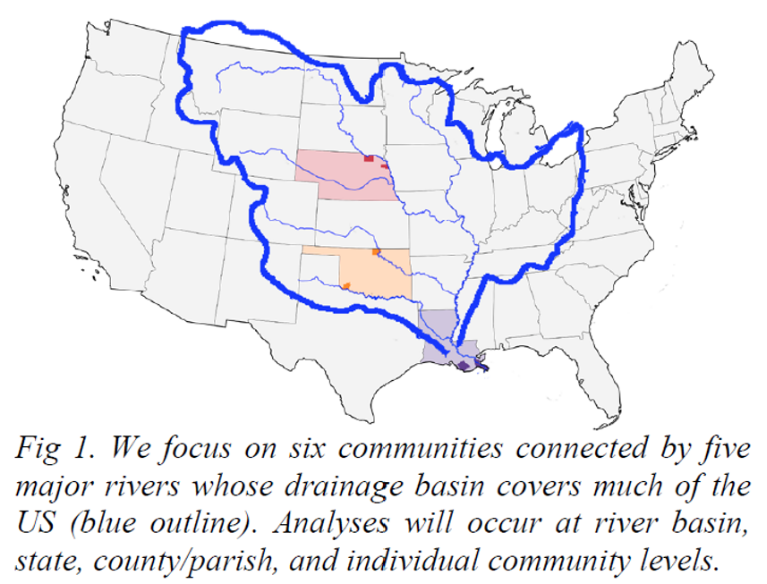
As the figure above shows, the Rural Confluence team works in three states: Oklahoma, Nebraska, and Louisiana. Faculty and staff from Oklahoma State, the University of Nebraska-Lincoln, Louisiana State University, Northern Oklahoma College, and Western Oklahoma State College make up the research and logistical team of Rural Confluence. The project is informed by an external evaluation team from Kansas State University.
The Rural Confluence project is a four-year-long, NSF EPSCoR-funded grant, so the research teams in Oklahoma, Nebraska, and Louisiana collaborate with two communities in each state to co-produce relevant resilience strategies.
We use four different aims to keep the overall goal of Rural Confluence in mind: increase climate resilience capacity for rural communities. Here’s a brief look into each aim and what its focus is:
Aim One: Co-develop a shared conceptual framework for rural climate resilience research and action informed by rural perceptions and priorities. This allows the research team to engage communities to identify common themes across regions to ultimately strengthen climate resilience in communities.
Aim Two: Project rural climate change impacts and community resilience scenarios using improved simulation methods. This aim requires integrated sciences to create enhanced models to project climate change impacts, climate resilience, and outcomes of potential local adaptation strategies and requires feedback from our partner communities to accurately assess plausible scenarios and responses.
Aim Three: Expand social and economic opportunities for disproportionately affected rural communities by helping them identify and pursue locally relevant climate resilience strategies. If rural residents work with team members to use the projections from Aim Two, they can identify and pursue the best-fit resilience strategies with the help of university students working in the communities each summer.
Aim Four: Broaden STEM workforce participation for people from rural and underrepresented backgrounds by developing diverse career pathways from K16 to Early-Career Faculty. Linking new educational and career training opportunities across rural schools, community colleges, and universities will provide a “braided river” of career pathways.
The title Rural Confluence highlights the communities in these three states are hydrologically, ecologically, and economically connected by the confluence of the five major rivers that drain the heartland of the US: the Mississippi, Red, Arkansas, Platte, and Missouri (Figure 1, see above). This riverine setting allows us to explore novel questions about upstream and downstream settings and build resilience for all.
What exactly does that mean? Stay tuned to find out, because the Rural Confluence team has now spent three years exploring questions we have heard from community members. Our team is made up of experts from across the Mississippi River Basin, but the real knowledge comes from listening to rural community members. Together, the team and community members create a confluence of knowledge and power for rural communities in the river basin and beyond.
References
1Center for Climate and Energy Solutions. (2025, September 17). What is Climate Resilience, and Why Does it Matter? - Center for Climate and Energy Solutions. https://www.c2es.org/document/what-is-climate-resilience-and-why-does-it-matter/
2Oklahoma State University, University of Nebraska–Lincoln, Louisiana State University, National Drought Mitigation Center, Northern Oklahoma College, & Western Oklahoma State College. (2022). RURAL CONFLUENCE.