
Climate Resilience Needs Differ in Rural and Non-Rural Areas, but Why?
The climate does not necessarily discriminate by location, as extreme weather events ramp up and make headlines on what seems like a daily basis everywhere. Floods, droughts, tornadoes, tsunamis, hurricanes, wildfires, and other weather events disrupt every landscape, no matter the population density. But extreme weather events are only one effect of climate change. Other, longer-term effects, like rapid erosion and altered landscapes, shifting weather patterns, changing local climates, and rising atmospheric and ocean temperatures, create even more challenges for everyone. Climate change affects all communities, but the effects vary for many different reasons related to socioeconomic factors, resource availability, infrastructure quality, and overall human well-being.
How communities can respond to short- and long-term effects of climate change varies a lot [1], too. Rural communities, often characterized by a dependence on natural resources and less populated spaces, face challenges of distributing limited resources over large areas, as well as limited infrastructure and methods to protect investments from ruin (e.g., think crops washed away by floods)[2]. Non-rural communities face higher population, building densities, and infrastructure, but these can concentrate heat and increase heat exposure for their populations, not to mention that the infrastructure itself can worsen storm damages (e.g., overflows of stormwater systems worsen flood damage)[3].
While much research has focused on climate change resilience in urban areas, Rural Confluence seeks to fill a research gap by focusing specifically on climate change responses in rural areas. The hope is that this research will better inform policy and decision-making around climate change resilience by articulating why rural areas are unique and need targeted solutions to build resiliency. Varied challenges require unique solutions, something Rural Confluence strives to accomplish.
How does climate change affect rural and non-rural areas differently?
To create lasting, climate-resilient solutions, we must understand the key differences between areas and why they differ. Below are some examples of how climate change requires different solutions in rural communities.
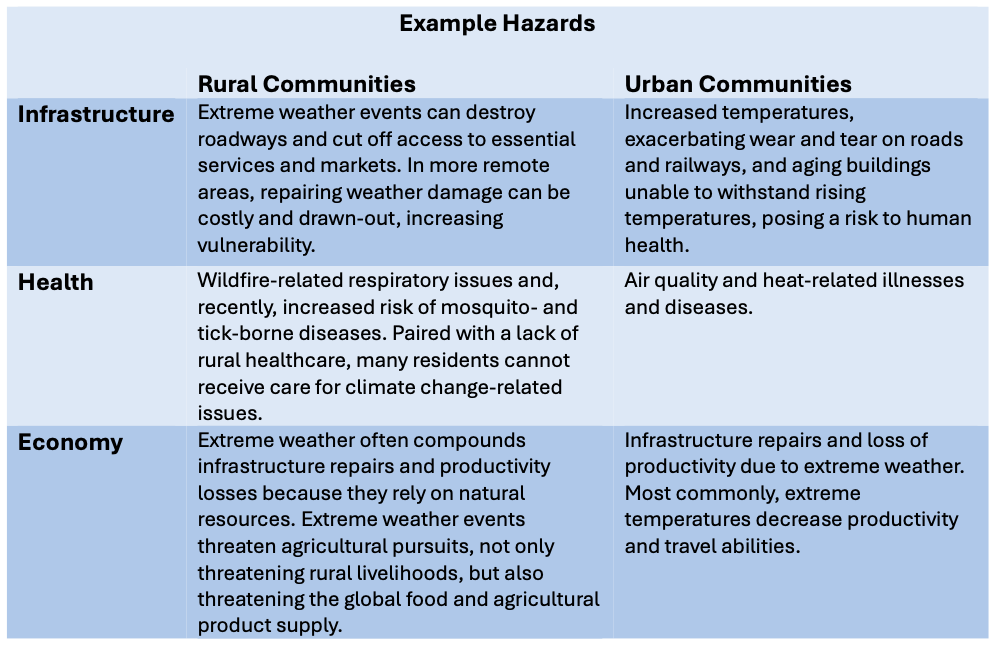
Knowing the different challenges climate change creates in urban and rural communities is only half of the battle. The second half requires tailored, actionable, and lasting solutions.
What are the different responses available for rural and urban areas?
Much of the previous research on climate resilience has focused on either urban or rural resilience, but it has failed to define the difference between the two [2]. We know both regions face climate-related issues, but how each population instinctively responds to climate stress is under-researched. Understanding the difference is important to continue developing plans for climate resilience. Without a basic understanding of needs and the reasons they vary, there would be no way to generalize findings to create broader action plans [2].
In 2022, Su et al. discovered the main difference between rural and urban climate resilience is independence. They found urban communities possess greater resilience in socio-economic categories such as infrastructure and community age structure. For example, … Conversely, rural residents tended to possess greater economic independence resilience and traditional knowledge resilience. Where urban areas are positioned to depend on the socio-economic structure, rural areas are predisposed to depend on individual knowledge and economic independence [2]. Rural areas rely upon individuals choosing to share equipment and resources, potentially at great personal cost, whereas urban areas often have local governmental departments with public equipment and plans to address climate stress; their challenge is maintaining order.
Rural communities not only face different climate stressors, but they also respond to them individually, limiting collective action. The Rural Confluence Project is helping rural communities develop collective actions for climate change response, and, in doing so, it hopes to build community resilience. A secondary bonus is that through the community-engaged research model employed, the Rural Confluence Project is also building community capacity in areas like planning, resource development, and leadership. Thus, the Rural Confluence Project hopes to not only fill a void of knowledge around rural climate change resilience, but it also hopes to build community capacity to address future challenges.
References
1Andrews, E., & Reiblich, J. (2020). Reflections on rural resilience: As the climate changes, will rural areas become the urban backyard? William & Mary Environmental Law and Policy Review, 44–44(3), 745–775. https://scholarship.law.wm.edu/wmelpr/vol44/iss3/4
2Su, Q., Chang, H., & Pai, S. (2022). A Comparative Study of the Resilience of Urban and Rural Areas under Climate Change. International Journal of Environmental Research and Public Health, 19(15), 8911. https://doi.org/10.3390/ijerph19158911
3Wang, Y., Mao, J., Brelsford, C. M., Ricciuto, D. M., Yuan, F., Shi, X., Rastogi, D., Mayes, M. M., Kao, S., Warren, J. M., Griffiths, N. A., Cheng, X., Weston, D. J., Zhou, Y., Gu, L., & Thornton, P. E. (2024). Thermal, water, and land cover factors led to contrasting urban and rural vegetation resilience to extreme hot months. PNAS Nexus, 3(4), pgae147. https://doi.org/10.1093/pnasnexus/pgae147
4Climate Change Impacts in Urban vs. Rural Communities. (n.d.). Stanley Consultants. https://www.stanleyconsultants.com/solutions/environmental-regulatory/blog/climate-change-impacts-urban-vs-rural-communities